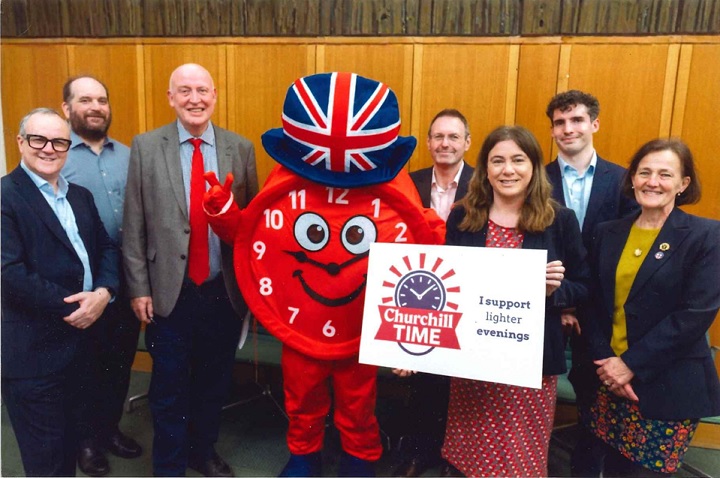
Nicola Foster (right), chair of RSGB, supporting the Churchill Time campaign
Road Safety GB is supporting calls for a change to Churchill Time, giving an extra hour of daylight for people driving home from work and walking home from school during the winter months.
Churchill Time refers to the proposal by Labour MP Alex Mayer to adopt a double British Summer Time system in the UK, which involves moving the clocks forward two hours in the summer and one hour in the winter.
The MP for Dunston and Leighton Buzzard argues this would make roads safer by extending daylight hours in the evening for most of the year, as well as save energy, help meet climate goals and boost the economy.
The name comes from a similar policy enacted during World War II under Winston Churchill to conserve energy.
Alex Mayer MP said: “There are considerable environmental and economic benefits from this plan, but one of the strongest and most immediate arguments is its potential to save lives and reduce injuries on our roads.
“The most dangerous time on our roads is between 3pm and 6pm. When the clocks fall back in October, this critical ‘rush hour’ window becomes darker – and the number of collisions rise. Research shows the road collisions increase by 19% in the two weeks following the clock change.”
Currently, the clocks go forward one hour at 1am on the last Sunday in March, and back one hour at 2am on the last Sunday in October. The period when the clocks are one hour ahead is called British Summer Time (BST). When the clocks go back, the UK is on Greenwich Mean Time (GMT).
The Churchill Time policy is also backed by the RAC Foundation, which estimates that it could save up to 40 lives and prevent more than 100 serious injuries every year.
Nicola Foster, chair of Road Safety GB, said: “Road Safety GB supports efforts to change to Churchill Time – also known as Double British Summer Time.
“We do however understand that the matter will not be judged purely on casualty reduction but on a wide range of economic and social issues.
“Nevertheless, we will fully support any future proposals brought forward on this issue that will directly reduce the number of collisions on our roads.”
Comment on this story