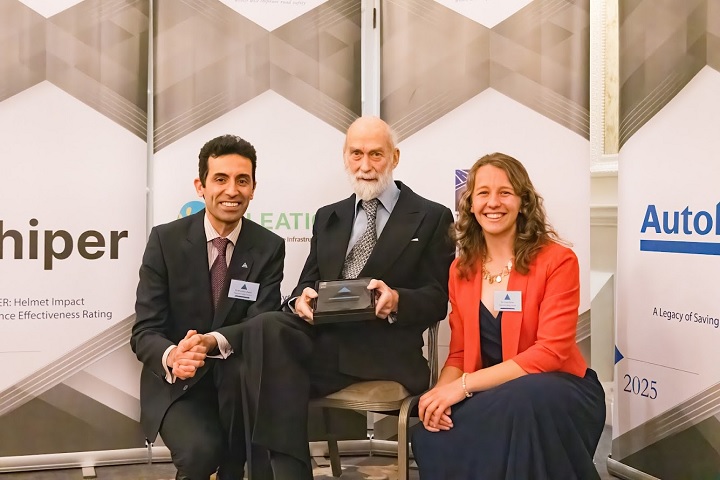
A research project, which culminated in a website that is helping tens of thousands of UK cyclists make informed choices when purchasing new helmets, has been recognised with a Prince Michael International Road Safety Award.
The Hiper website was created by researchers at Imperial College London, who developed a simple new cycle helmet safety rating system – and tested the UK’s 30 most popular helmets – thanks to funding from The Road Safety Trust.
The results of the testing revealed significant differences in performance with no link between the price of a helmet and the level of safety it provides the wearer. So, for example a helmet costing £130 did not perform better in tests than one costing £40.
The ratings were published on the Hiper website, helping cyclists to select which helmet to buy and assist manufacturers in future helmet design.
Data shows that more than 120,000 people accessed the website in the year after it was launched in September 2024, from the UK and beyond.
The website has also prompted retailers to lower the prices of their better-performing helmets, while manufacturers have sought to innovate their designs for improved safety performance.
In the long term, it’s hoped that this will reduce head injuries in cycling incidents.
Dr Mazdak Ghajari, associate professor in brain biomechanics, Imperial College London, said: “We are hugely honoured to receive this prestigious road safety award.
“This affirms the real-world impact our translational research is already having through the helmet rating programme. It is a key moment for our team and a powerful motivation as we take the next steps in our journey.”
Founded and presented by HRH Prince Michael of Kent, the awards program has been honouring outstanding achievement and innovation in road safety since 1987.
Ruth Purdie OBE, chief executive of The Road Safety Trust, said: “I’d like to congratulate the team at Imperial College London for the recognised success of the Hiper website.
“I’m delighted to see that the cycle helmet rating system is having such a widespread – and potentially lifesaving – impact.”
Comment on this story