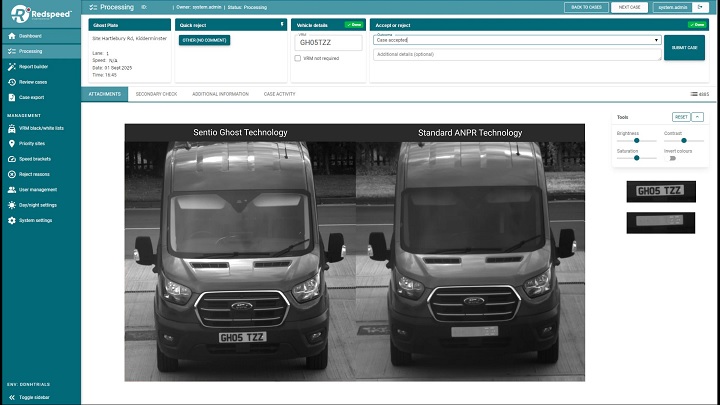
Image: RedSpeed International
A new report is warning that the UK’s outdated and poorly regulated number plate system has created a vast and rapidly growing crisis that enables criminals to operate undetected on the UK’s road network, lets dangerous drivers off the hook and poses serious safety concerns.
The All-Party Parliamentary Group for Transport Safety (APPGTS) launched the report following a cross-party inquiry into vehicle registration plates, following calls from MPs and experts who had drawn attention to a brewing crisis in road safety.
The UK’s advanced Automatic Number Plate Recognition (ANPR) system, now capturing around 90 million reads each day across more than 18,000 cameras, is being critically undermined by weak regulation of number plate production, supply and a lack of enforcement.
As many as one in fifteen vehicles may carry modified, non-compliant plates including ‘ghost’ and stealth plates designed to evade ANPR detection. These plates, often sold openly online by unregulated suppliers, enable drivers to avoid paying road charges, tolls, congestion fees and fines.
But the problem extends far beyond traffic offences. Criminals are using ANPR-evasive plates to facilitate activities including rogue trading, drug dealing and organised crime such as human trafficking and people smuggling.
The inquiry heard from National Trading Standards that “Ghost plates pose a serious threat to counter-terrorism operations. Vehicles with stealth plates can bypass surveillance systems around critical infrastructure such as airports, government buildings, and transport hubs. This creates vulnerabilities that could be exploited by terrorist groups planning vehicle-borne attacks.’’
The report exposes ‘extraordinary weaknesses’ in number plate manufacturing
Some 34,455 suppliers are registered with the DVLA to produce UK number plates, with many operating from private homes or small workshops, with no background checks in place. Some suppliers handling customers’ ID documents were found to have serious criminal convictions, including for violent offences and fraud.
Meanwhile, innocent motorists are increasingly being targeted by criminals who clone their number plates. Many have found themselves accused of offences they did not commit, facing fines, debt collection, and in some cases, police investigation. The personal impact of this tampering is a scandal.
The widespread use of ghost, tampered and cloned plates poses an acute risk to public safety. The report highlights evidence that taxi drivers are tampering with plates en masse to avoid drop-off and road charges. The inability to trace these vehicles raises serious risks for women and girls’ safety, as well as for vulnerable passengers.
In London, this is an issue that is being tackled head on. Of 1,000 vehicle checks, carried out by Transport for London (TfL), using ‘ghost’ plate-defeating cameras, 41% of licensed taxis were found to have non-compliant plates. Since acquiring more of these cameras in July 2023, TfL has issued more than 4,200 fines. Subsequent deployments, checking around 800 vehicles, showed a reduced rate of 38% ghost or stealth plates, suggesting enforcement had an impact.
Call for urgent reform
The report concludes that the current registration plate system represents a “gaping hole” in the UK’s security and policing infrastructure, one that can be exploited using nothing more sophisticated than cellophane, leaves or a marker pen.
It advocates for wholesale revision of the registration plate system from production to supply, usage and management. Self-funding solutions exist that would tackle the flaws in the current system with relative ease – but changes need to be multi-pronged and to include all of the relevant stakeholders.
The implementation of this reform would achieve nothing short of transforming safety and fairness, both on our public roads and far beyond them.
The key recommendations as outlined in the report are:
- Standardise design of registration plates, with security features to bring the UK up to international standards. Ban the use of 3D and 4D plates.
- Significantly restrict the number of licenced sellers via annual fees, regular audits and removal of non-compliant sellers.
- Increase the fine and give offenders points for use of an illegal plate and seize vehicles of repeat offenders.
Simon Williams, RAC head of policy, said: “It’s clear from this report that urgent action must be taken to stop the widespread abuse of number plates, which has serious and far-reaching consequences for our society from road safety to national security. Ghost and cloned plates have no place on our roads as no one should be able to drive a vehicle that’s invisible to enforcement cameras or untraceable by the police.
“It’s vital we introduce new, higher security standards for number plates and those who produce them.”
Martin Saunders, head of uninsured driving prevention at the Motor Insurers’ Bureau, said: “MIB exists to protect people from the devastation of uninsured and hit and run drivers. The increasing damage done by drivers of vehicles hiding in plain sight on our road system should not be tolerated.
“There is an urgent need for a partnership approach to implement the recommendations made in this report to make our road system safer and ensure every vehicle is able to be quickly and readily identified by the number plate it exhibits.”
Comment on this story