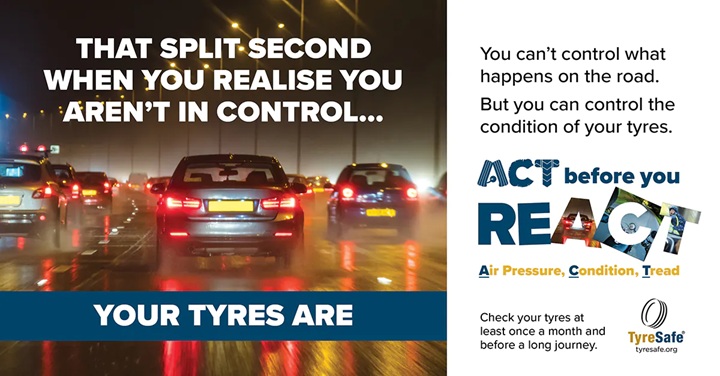
New research from TyreSafe suggests a widespread misunderstanding among UK drivers about stopping distances, with many overestimating their ability to stop safely in wet conditions.
The findings, released to mark the launch of Tyre Safety Month, show that 83% of drivers believe they are in full control of their vehicle’s stopping distance.
TyreSafe says the findings highlight a significant gap between driver confidence and the reality of stopping in adverse conditions. Its research indicates that 94% of drivers underestimate the additional stopping distance required in wet conditions, with some underestimating it by a considerable margin.
The issue appears to be widespread across all regions of the UK, according to TyreSafe, highlighting the importance of driver awareness and vehicle maintenance as rainfall and changing seasonal conditions increase.
Stuart Lovatt, chair of TyreSafe, said: “Many drivers and riders believe they are in control – but that confidence is often misplaced.
“Stopping distances in wet conditions can be far greater than expected, and tyres play a critical role in that equation.
“If your tyres are not properly maintained, your ability to stop safely is significantly reduced – no matter how confident you feel behind the wheel.”
TyreSafe is urging motorists to check their tyres regularly, particularly ahead of seasonal changes and periods of increased rainfall.
The organisation is promoting its ACT message, encouraging drivers to check:
- Air pressure – ensure tyres are inflated to the vehicle manufacturer’s recommended pressure.
- Condition – check for cuts, cracks, bulges or other signs of damage.
- Tread depth – ensure tyres have sufficient tread to provide grip, particularly in wet conditions.
TyreSafe says that understanding the relationship between road conditions, stopping distances and tyre condition is an important part of staying safe on the road.
I think this is in the context of sudden ‘panic ‘ braking, rather than normal controlled everyday braking situations. In the former, on a wet road, the wheels may lock-up, obviously increasing the stopping distance and a lot of drivers aren’t aware of this, don’t anticipate it and therefore don’t know what to do when it happens. ABS helps, but again if the driver has not familiarised him or herself with the operation of ABS, they may not be able to cope when it kicks in.
Before ABS, anyone serious about safe driving should have familiarised themselves with cadence braking to counteract the wheels locking-up – I suspect this is has become a dying art. The principle obviously also applies to driving on snow and ice, where any application of the brakes – even gentle, at any speed – could cause wheel lock-up.
Hugh Jones, South Wirral
+1