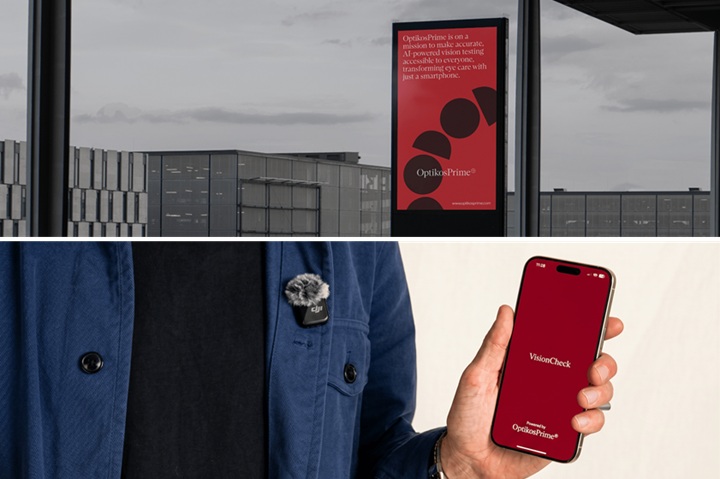
In this opinion piece, Graham Lewis-Dale from OptikosPrime calls into question the strength of the current eyesight testing for UK drivers, in particular the 20 metre number plate check.
Twenty metres is not very far.
Twenty metres is about five car lengths. Pace it out in a car park sometime, turn round, and look at your own number plate. It really is not very far.
That distance, twenty metres, or twenty and a half depending on the plate, is the whole of the eyesight test for driving in this country. You do it once. Usually at seventeen. In daylight, standing still, on a plate whose format you already know. After that nobody checks again. At seventy you tick a box confirming your vision still meets the standard, and you tick it again every three years. Nobody verifies the box.
I should declare an interest. I work for OptikosPrime, which makes a smartphone vision screening tool. I will come back to that briefly at the end.
We set a floor, then treated it as a target
The legal standard is not only the plate. A driver also needs visual acuity of at least 6/12 on the Snellen scale using both eyes together, and an adequate field of vision. Six over twelve is roughly half of what most of us would call normal sight. It is a legitimate place to draw a line. Somebody has to draw one.
What bothers me is what we have done with the line since.
Nobody in road safety treats the drink-drive limit as an ambition. No fleet manager has told a driver that a tyre at 1.6mm is a good tyre. We are fluent in the difference between what is legal and what is safe. It is most of what this sector does.
Vision is the odd one out. “Meets the minimum” quietly became “has fine eyesight”, and the conversation stopped there. Whether 6/12 is the right threshold is for clinicians and legislators. My point is narrower: a number designed as a floor has become a ceiling on our ambition, and that was a choice.
The test misses the things that actually go wrong
Reading a plate in good light tells you about distance acuity in good light. That is all.
It says nothing about contrast sensitivity, which fails first in early cataract and decides whether you pick a pedestrian out of a wet dusk. Nothing about glare recovery from oncoming headlights. Nothing about visual field, despite an adequate field being part of the standard, which means a driver with early glaucoma reads that plate perfectly and still does not see the cyclist on their left.
The casualty data will not win this argument, and I would rather say so
Here is the part that cuts against me.
Uncorrected or defective eyesight was recorded as a contributory factor in 196 reported collisions in 2018, three of them fatal. That is well under 2% of reported collisions. The Road Safety Observatory goes further and says the evidence linking poor vision to crash risk is weak.
If you want a reason to leave this alone, there it is.
But think about how that number is made. An officer records eyesight when it is obvious, admitted, or established later. There is no vision test in the ordinary course of a collision investigation. We are not measuring this and finding little. We are mostly not measuring it. There is no official estimate of how many drivers are below the legal standard, though the literature suggests around 2 to 3%.
A hole in the data is not a finding. Anywhere else in our work we would treat “we do not record it, so it is not happening” as a reason to fix the recording.
This has stopped being theoretical
January’s Road Safety Strategy commits to cutting deaths and serious injuries by 65% by 2035. Alongside it, DfT consulted on mandatory eyesight testing for older drivers to replace self-declaration at renewal. That closed on 11 May and we are still waiting for the response.
The optical bodies want it to go further still, with every driver evidencing a sight test at every renewal. Age UK’s submission shows why that is harder than it sounds: 6.3 million drivers aged 70 and over, two million renewals a year, and real concerns about rural access and cost.
Whichever way the response goes, somebody has to deliver it. That problem is ours.
Where a phone fits, and where it does not
So, the declared interest. VisionCheck screens for refractive error using a phone’s flash and the reflection off the retina. It takes a minute. On recommended handsets with practised users it is 94% accurate. Across all devices and first-time users that drops to 86%, and borderline cases come back as inconclusive rather than guessed.
What it cannot do matters more. It does not detect glaucoma, cataract, macular degeneration or field loss, which are the conditions that dominate risk in older drivers. It is not a sight test. Its only real job is to tell someone something has changed and they should book an appointment with an optometrist who can find what a phone cannot.
That is a small claim, deliberately.
The question I would put to the sector
Forget the technology. When we talk to fleets, instructors, learners and older drivers, are we asking them to clear the legal minimum, or to see as well as they reasonably can?
We have that conversation about speed and alcohol every week. We have never really had it about vision, largely because the test we inherited is easy and the data we collect is quiet.
Twenty metres is not very far. We should stop pretending it is.
Comment on this story