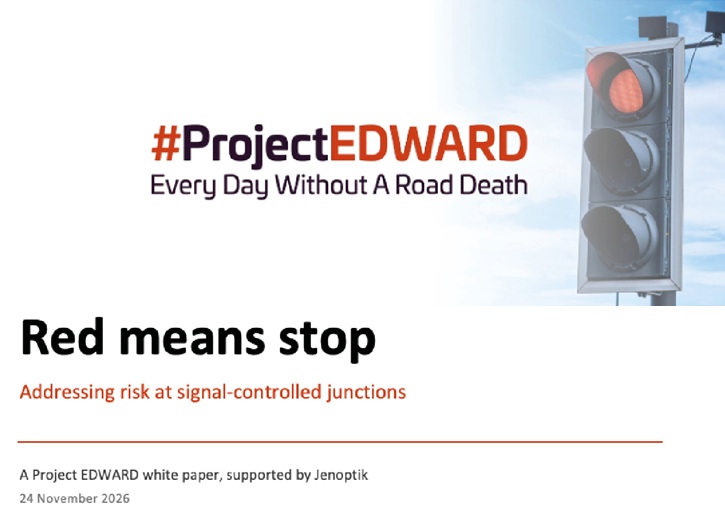
Police and highway authorities are being urged to give greater priority to safety at traffic-light junctions, following the publication of a new report highlighting the risks associated with red-light running and dangerous approach speeds.
The white paper, Red means stop: addressing risk at signal-controlled junctions, has been published by Project EDWARD with support from Jenoptik, and calls for an evidence-led approach combining engineering, education and enforcement.
Analysis included in the report identifies 56,431 reported injury collisions associated with signal-controlled junctions across Great Britain between 2021 and 2025. This includes 405 fatal collisions.
The report stresses that these figures relate to collisions rather than casualty numbers, and do not establish that red-light running was responsible for each incident.
It calls on police, highway authorities and road safety partnerships to investigate local risks, identify appropriate interventions and measure their effectiveness.
James Luckhurst of Project EDWARD said: “A green light should not become a gamble because someone else ignores a red one. We want this paper to prompt practical conversations about junction safety: where people are being hurt, what is going wrong and which measures will make the greatest difference.
“This is not a call for a camera at every junction. It is a reminder to understand the problem and act.”
The white paper includes case studies from West Yorkshire and Scotland, demonstrating how collision analysis, local investigation and engineering judgement can help inform decisions about junction safety.
These examples also highlight the importance of considering different interventions, with changes to crossing provision sometimes being more appropriate than enforcement.
Nathan Howard of Jenoptik said: “Technology should serve a clearly-defined safety need. Combined red-light and speed enforcement can help partnerships address dangerous behaviour, but deployment must follow evidence, not assumptions.
“Success means safer journeys, not higher ticket totals.”
The report recommends establishing baseline data, assessing the suitability of individual sites and evaluating the benefits of interventions alongside any unintended consequences.
Nathan Howard and representatives from Transport Scotland will discuss the findings during Project EDWARD’s December ‘First Friday’ webinar on 4 December, from 08:00–09:00. The session will also provide an opportunity for attendees to ask questions.
Comment on this story