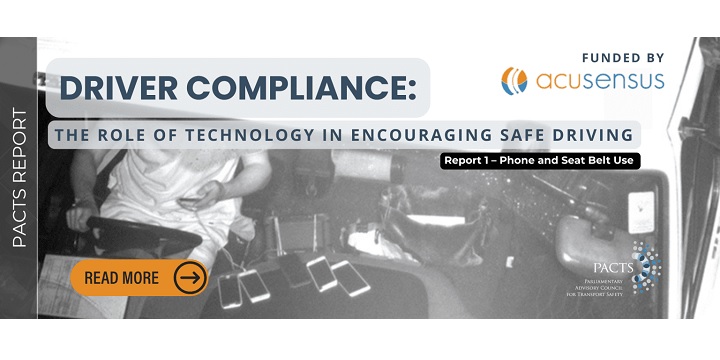
A new report examining how the UK monitors and enforces two persistent high-risk behaviours within the ‘fatal four’ – not wearing a seat belt and using a mobile phone while driving – has called for increased use of emerging technologies.
Published by PACTS and supported by funding from Acusensus, the report is informed by evidence from police forces, local authorities, researchers, technology providers and legal specialists.
It highlights that both behaviours remain serious and under-detected risks on UK roads.
In 2023, 64.9% of fatal collisions in Great Britain involved at least one fatal four factor, yet current approaches to monitoring seat belt and mobile phone compliance rely heavily on sporadic roadside observation, capturing only a fraction of real-world behaviour.
While official observational surveys report high seat belt wearing rates, unbelted occupants continue to be heavily over-represented in fatalities, and mobile phone distraction remains culturally normalised despite low detection levels.
Technology offers a turning point
PACTS’ review finds that new technologies – including AI-enabled camera systems, in-vehicle monitoring, and phone-limiting apps – offer credible and scalable ways to detect, deter and better understand non-compliant behaviour.
Evidence from UK trials of AI roadside cameras, such as those developed by Acusensus and deployed with National Highways and police forces, shows they can identify thousands of offences within hours and deliver a measurable deterrent effect when publicised.
Key recommendations
To support safer roads within a Safe System framework, PACTS recommends:
- Modernising the legal framework to enable automated detection of seat belt and mobile phone offences, supported by mandatory human verification.
- Reviewing penalties for both offences, including the use of educational diversionary courses.
- Creating national coordination to ensure consistent deployment, data governance and evidential standards for AI-enabled enforcement.
- Scaling up technology-based enforcement with transparent evaluation of accuracy, fairness and privacy safeguards.
- Strengthening employer and fleet action, including wider use of telematics, in-vehicle alerts and robust driving-for-work policies.
- Using aggregated data from emerging technologies to provide richer national insights into risky behaviours.
Alison Hernandez, police and crime commissioner for Devon, Cornwall and the Isles of Scilly, and Chair of Vision Zero South West, said: “Our work with Acusensus has shown just how common these offences still are, and how much positive change can be achieved when new technology is used alongside strong communications.
“We have seen sustained reductions in offending at sites where cameras operate, even after they have been removed. This approach is already making a real difference and we hope it will contribute to fewer deaths and serious injuries on our roads.”
Jamie Hassall, executive director of PACTS, said: “While compliance is high due to the volume of traffic, the risk from these behaviours puts everyone at risk. It’s clear that there are a larger percentage of companies that are not meeting their legal obligations in keeping their drivers and the public safe.
“They are failing to take reasonably practicable steps to remove the risk of their drivers using mobile phones or not wearing seat belts. They have failed to learn from tragic collisions and the enforcement system focuses on the driver and not the companies, as unlike other work-related deaths the H&SE don’t get involved as they are not deemed reportable.
“We have a failing system that means more families will be devastated until changes are made.”
So Chris :-
1. Who is “we”?
2. What measures would you put in place to negate the effect of drivers using mobile phones?
3. What evidence do you have that punishment or sanctions do not “change behaviour en masse”?
Rod King, Lymm
0
What measures to negate the negative outcomes would you suggest Chris?
Hugh Jones, South Wirral
0
A “safe system” does not look at ways to punish users of the system, in fact a safe system would expect such failures and put in place measures to negate the negative outcome of said failures.
We have tried and failed to use punishment to change behaviour en masse and it hasn’t worked, more punishment will simply increase the level of failure in tackling the issues.
Chris, Bristol
--3