Image: RAC press and policy office
August recorded the highest average number of drink-drive casualties and collisions of any month between 2014 and 2024, according to analysis of government data by the RAC.
The analysis found that an average of 721 people were killed or injured in drink-drive collisions in August each year over the 11-year period, across an average of 485 collisions.
July was the second-highest month, with an average of 704 casualties from 474 collisions.
The figures suggest that drink-driving is a greater summer risk than is often recognised, with June to August averaging 16% more drink-drive casualties than December to February over the 11-year period. Drink-drive collisions were also 16% higher during the summer months.
December – traditionally associated with increased drink-driving because of Christmas and New Year celebrations – recorded an average of 663 casualties from 459 collisions.
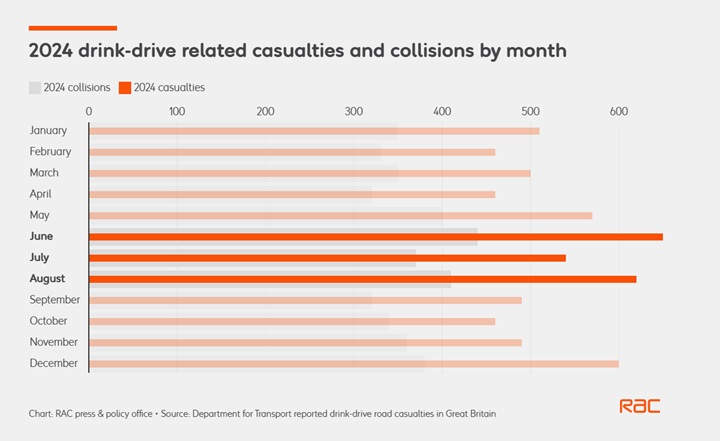
The latest available figures show the same pattern. In 2024, June recorded the highest number of drink-drive casualties and collisions, with 650 casualties and 440 collisions.
Across June, July and August there were 1,810 drink-drive casualties and 1,220 collisions, compared with 1,570 casualties and 1,060 collisions during December, January and February.
‘More opportunities and temptation’
RAC head of policy Simon Williams said the findings challenge the perception that drink-driving is primarily a Christmas issue.
He said: “Drink-driving is often seen as more of a Christmas issue, but our analysis shows collisions involving drivers who have consumed illegal levels of alcohol are actually far more common during the summer.
“Warmer weather, longer evenings as well as holidays, festivals and barbecues all create more opportunities and temptation for people to drink and then get behind the wheel.
“Anyone who has drunk alcohol on a summer’s evening or weekend shouldn’t get behind the wheel until they’re absolutely sure they’re safe to drive. This advice is especially important as the UK experiences a summer that’s so far been characterised by largely fine weather and, for some, successive heatwaves.”
Williams also highlighted the additional risks posed by tiredness and dehydration during hot weather.
He said: “It’s also important to be mindful of the effects of tiredness which can affect people who struggle to sleep in very hot conditions. Tiredness, dehydration and alcohol can be a lethal combination behind the wheel.
“Enforcement of the drink-drive law at this time of year is therefore extremely important in keeping everyone safe.”
Call for alcohol interlocks
The RAC is also continuing to call for stronger measures to tackle repeat drink-driving, including the introduction of court-ordered alcohol ignition interlocks, or ‘alcolocks’, for high-risk and repeat offenders.
The organisation says nearly 27,000 drivers were convicted of drink-driving more than once over an 11-year period.
Alcohol interlocks require a convicted drink-driver to provide a negative breath test before their vehicle can be started.
Williams said: “As we’ve highlighted in the past, repeat offending is a genuine problem with nearly 27,000 drivers having been convicted more than once over an 11-year period.
“Drivers strongly support alcohol interlocks which require a convicted drink-driver to provide a negative breath test in order for their vehicle to start.
“We – alongside the Lock-Out Drink-Driving campaign – continue to urge the Government to allow courts to mandate them.”
Comment on this story