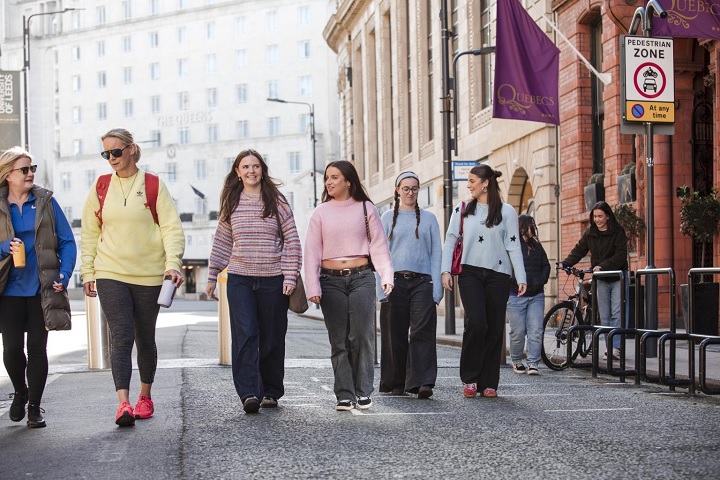
New Government guidance will be issued to councils nationwide to help them consider how to make their streets safer for women and girls.
New polling by YouGov has found that almost nine in 10 (88%) women have felt unsafe while walking at night, while seven in 10 (71%) have changed their route to avoid walking in the dark during winter or darker months.
Inadequate lighting, poorly maintained routes, personal safety fears and antisocial behaviour were identified as key barriers, with the majority of respondents saying they would feel safer walking in their neighbourhoods if key issues were addressed.
New Government guidance will be published in 2026 alongside training sessions in the Spring, outlining how local authorities can design their streets to be safer for women and girls.
The guidance will introduce how looking at active travel through the lens of gender can help create safer and more inclusive places, including explaining the importance of implementing better-designed street lighting and improved visibility, as well as established walking routes along roads that are generally busy and overlooked by other people and CCTV.
Lilian Greenwood, local transport minister, said: “No one should worry about getting to their destination safely after dark, and these stats show just how much work there is to be done.
“This programme is turning conversations into real change by working directly with the councils who design our streets to ensure women and girls in our communities feel safe to walk, wheel and cycle whenever they want to.”
Chris Boardman, national active travel commissioner, said: “That almost nine out of 10 women say they feel unsafe walking after dark is an appalling finding we should be ashamed of.
“For too long, we have designed streets that don’t work for women and girls. We want to help councils remove the barriers that are stopping women and girls from choosing to walk and wheel – whether that’s by providing better lighting, surface crossings over underpasses, CCTV or simply by listening to and acting on lived experiences.
“It’s a terrible thing that women and girls don’t feel they have the same freedoms to simply walk in their neighbourhood as men and boys. Everyone should feel safe getting around, and our job is to help make that happen.”
Towns and cities across the country have already taken steps to improve street safety for women and girls.
This includes Nottinghamshire County Council’s Safer Streets scheme in Worksop, which delivered 27 new CCTV cameras in locations where women flagged feeling unsafe, 200 streetlight upgrades in key hotspots, and training for taxi drivers on addressing misogynistic behaviour.
Milton Keynes City Council has delivered bystander champion training for male staff in the night-time economy and has created a designated safe route through to the rail station with improved visibility.
In Liverpool, Merseyside Police are set to launch ‘Halo Points’ across the city centre. These are well-lit, highly visible points linked directly to emergency services and CCTV. Meanwhile, in Leicester and Greater Manchester, underpasses have been removed and replaced with on-street crossings.
ATE’s guidance will also refer to interventions that have been put in place worldwide. This includes Amsterdam, The Netherlands, where the council has set out proposals to cover a range of ways to better consider the needs of young women, including evaluating the design of places at dusk and in darkness.
In Vigo, Spain, there has been success introducing night bus request stops, which allow women and girls to ask bus drivers to stop anywhere along the route at night, rather than just at official stops. This reduces the distance women walk alone from a bus stop to home.
Comment on this story